
Illinois DCFS Uses Augintel to Uncover Bias
The Office of Racial Equity Practice at DCFS could track investigations, placements, and permanency outcomes.
Learn how Maryland DHS uses AI to analyze the case notes their workforce was already writing →


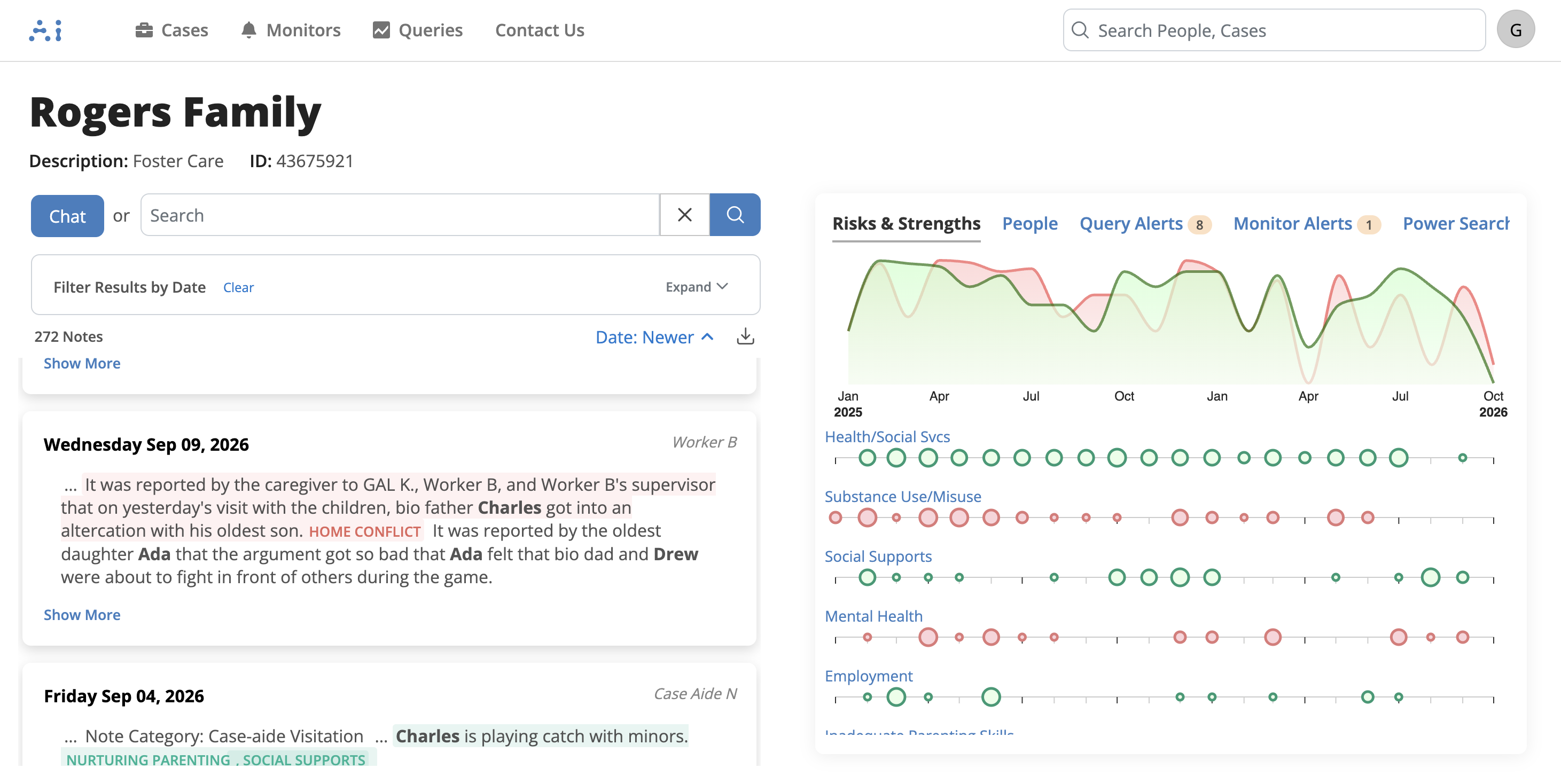

Allegheny County, Pennsylvania, home to Pittsburgh and more than 1.4 million residents, has a Department of Human Services (DHS) focused on creating an accessible, culturally competent, integrated, and comprehensive human services system. Within DHS, the Office of Children, Youth and Families (CYF) oversees child welfare, supported by the Office of Analytics, Technology and Planning (ATP).
Together, these teams have built a strong partnership between technology and practice, helping establish DHS as a recognized leader in innovative approaches to child welfare.
One opportunity stood out: making the information buried in unstructured text more accessible to case teams. Case notes, safety plans, assessments, and other records contain valuable information about families, but finding and analyzing that information can be difficult and time-consuming.
As Maryn Formley, Casework Specialist Supervisor and operations lead for DHS's KIDS child welfare case management system, explains:
“There are thousands of places where our systems require a paragraph, a description, or another note. There is rich data in the notes. Those notes tell the story of that family.”
Recognizing the importance of shared case knowledge, the ATP team turned to Augintel's natural language processing (NLP) technology to make those insights easier to find and use.
Allegheny County began with a pilot involving 80 caseworkers, clinicians, supervisors, specialists, and paralegals. This cross-functional group helped tag data, test functionality, and assess the accuracy of the technology.
To evaluate usability, ATP organized a scavenger hunt, comparing how long it took participants to locate specific case information using Augintel versus their existing case management system. The results demonstrated that Augintel could find information faster, saving valuable time for caseworkers.
Following the successful pilot, DHS moved to a full rollout across more than 400 CYF staff. The transition from pilot to implementation took less than six months, and the benefits quickly became apparent to field teams.
For Caseworker Cristy Bearden, Augintel has made a measurable difference in her daily workload. She estimates that the platform saves her approximately five hours each week that she previously spent searching case notes or preparing for court.
That time can now be spent on more impactful work with children and families.
Court preparation is one area where the difference is especially clear. Before a hearing, Cristy would typically spend days rereading case records and making notes to prepare for questions from the judge.
“I saved so much time prepping for court. And while in court, any time there was a question, I was able to search the notes and give the judge the answer very quickly. Using Augintel, it was just all right there for me.”
Cristy also relies on Augintel for weekly supervision reviews, quickly retrieving information her supervisor requests, such as whether fathers have been engaged or specific medical information has been obtained.
The platform is equally useful when she needs to cover another caseworker's caseload. Augintel's case dashboard helps her quickly understand a family's strengths and risks, while searches can surface discussions of specific topics, including mental health and drug and alcohol abuse.
But one particular use of the technology stands out: family-finding.
Cristy recalls working with a child who had been removed from the home. She was struggling to identify a family placement and remembered that relatives had been mentioned much earlier in the case. The case spanned several years, and the file was extensive. Finding the original reference through a manual review might have been extremely difficult.
With Augintel, she quickly located the notes and identified a grandmother who could provide placement.
“I was able to place the child with the grandmother and avoid that child going to foster care,” Cristy said.
It was a practical example of how making existing information easier to access can directly influence decisions for children and families.
The ATP team is encouraged by Allegheny County's early results and is already exploring additional ways to build on the implementation.
Formley says the team is listening to current users, identifying new opportunities to improve the tool, and analyzing what can be learned from unstructured data.
Future plans also include exploring applications in other DHS program areas, including housing and family support.
For Allegheny County, the work demonstrates how natural language processing can help turn the information already captured in case records into accessible knowledge—supporting more informed decisions, stronger supervision, and more time for the work that matters most: supporting children and families.


The CIO at a Denver behavioral health center talks about how NLP can help with behavioral health, what it will take to get more providers to adopt the AI technology – and how it can help with managing social determinants data.

In this video, longtime social worker and supervisor Christine shares her experience using AI for the first time.

“To be able to quickly scan and access case notes across multiple domains such as health, education, and family engagement has improved our review, training, supervision, and risk mitigation practices.”




In child welfare, there’s no substitute for the judgment, experience, and dedication of caseworkers. We believe AI is a support tool – not a replacement – for that expertise. Our AI uses natural language processing to analyze case notes, identify patterns, and surface warning signs. All to help caseworkers better serve children and families.
© 2026 Augmented Intelligence Technologies, Inc.