
Illinois DCFS Uses Augintel to Uncover Bias
The Office of Racial Equity Practice at DCFS could track investigations, placements, and permanency outcomes.
Learn how Maryland DHS uses AI to analyze the case notes their workforce was already writing →


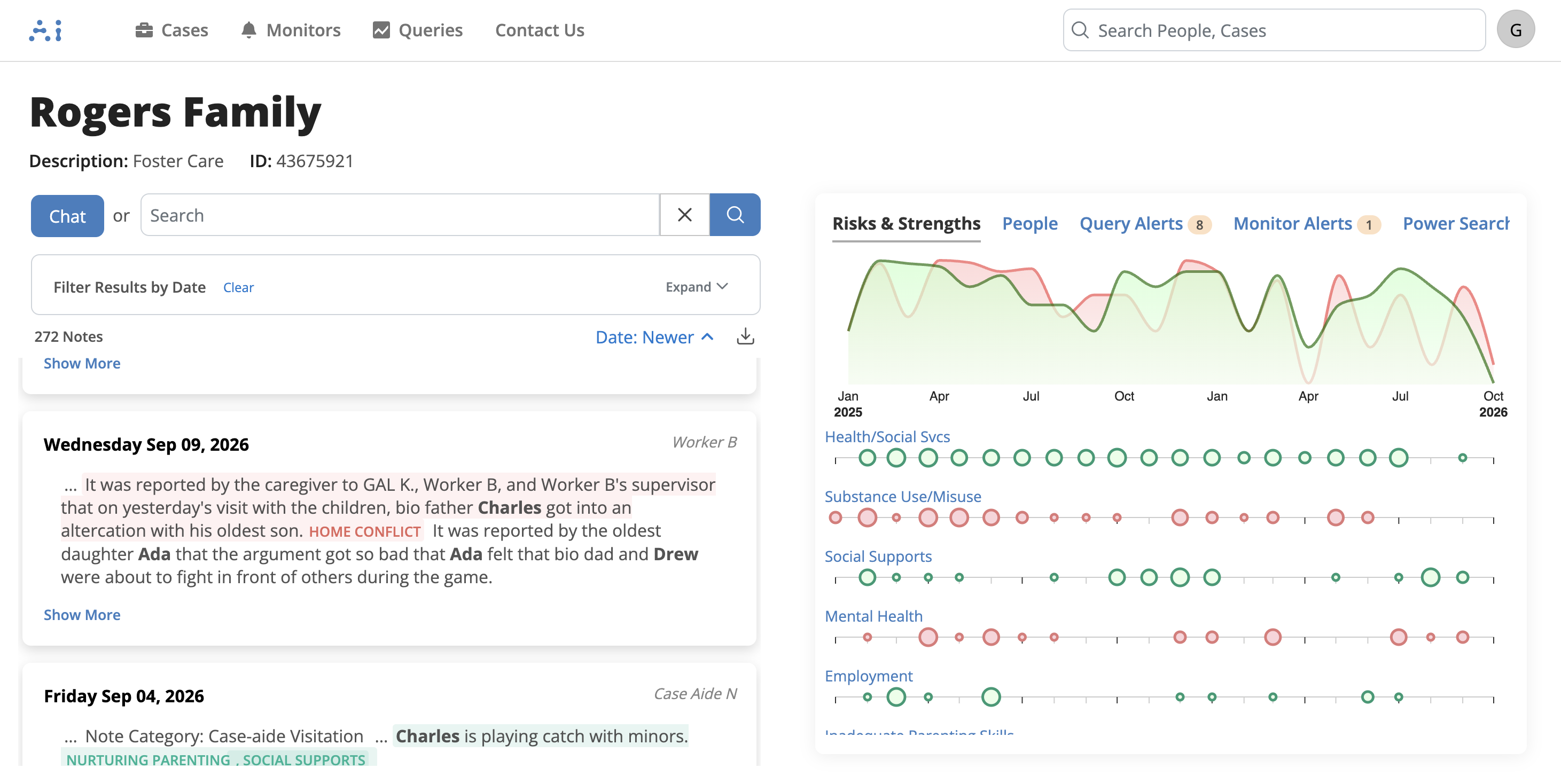
We are at the beginning of a significant shift in child welfare information systems, and we are excited about the possibilities. Between us, we have more than 40 years of experience as child welfare professionals. Throughout our careers, we've encountered systems that created more administrative work than practical support for caseworkers. The next generation of Comprehensive Child Welfare Information Systems (CCWIS) has an opportunity to change that.
One of the primary goals of CCWIS is to help agencies become more data-driven. Better access to data can help agencies identify trends, understand which practices are working, and make more informed decisions about services and outcomes. But achieving that goal requires access to all agency data, including both structured information and unstructured data such as case notes and communications.
We're concerned about a trend toward reducing unstructured data by converting more information into structured fields, such as checkboxes and drop-down menus.
There is certainly value in structuring repetitive information that can be consistently captured. But most case notes should remain free-form text. Families have unique circumstances and needs that cannot always be captured in predefined categories.
Consider a few examples:
These examples illustrate why narrative information is so important. Structured data can tell us what happened, but case notes often help explain why and provide the context needed to understand a family's circumstances.
The answer isn't to choose between structured and unstructured data. Agencies need both.
Innovations like Natural Language Processing (NLP) make it possible to analyze large volumes of free-form text and turn that information into insights that agencies can use. Rather than asking caseworkers to document everything in checkboxes, agencies can use technology to unlock the value already contained in their case notes.
With federal funding, advances in NLP, and ACF's support for systems that reflect individual state child welfare practices, there is an opportunity to build information systems that genuinely support the workforce.
The next generation of CCWIS should not repeat the mistakes of the past. Modernization should be about more than meeting reporting requirements or collecting additional structured data. It should make information more accessible, improve decision-making, and support the complex work of serving children and families.
Families don't fit into boxes. Our technology shouldn't force their stories into them, either.


Allegheny County’s caseworkers had rich data buried in notes. Now they can find it in seconds.
Maryland DHS used AI to review nearly 2,000 child welfare case files in 60 days. See what it found, how it worked and how to get started.

How AI-powered narrative analytics helped Massachusetts' child welfare team find a home that kept four siblings together, and how it’s changing what agencies can see in their case records.




In child welfare, there’s no substitute for the judgment, experience, and dedication of caseworkers. We believe AI is a support tool – not a replacement – for that expertise. Our AI uses natural language processing to analyze case notes, identify patterns, and surface warning signs. All to help caseworkers better serve children and families.
© 2026 Augmented Intelligence Technologies, Inc.